The 1972 to 1982 Ford Courier is a classic piece of automotive history. During this era, it wasn't actually built by Ford, but was instead a "captive import" manufactured by Mazda.
Ford introduced the Courier to the North American market to compete with the surging popularity of compact Japanese pickup trucks like the Toyota Hilux and the Datsun Truck, without having to spend the time and money developing their own small truck from scratch.
Here is a breakdown of the Ford Courier during this ten-year run:
This generation was essentially a rebadged Mazda B-Series (specifically the Mazda Proceed/B1600), modified slightly to appeal to American buyers.
Design: Ford gave the Courier a unique front grille featuring dual single headlights to mimic the front end of the larger, highly successful Ford F-Series trucks.
Engine: It was powered by a 1.8-liter Mazda overhead-cam inline-four engine, producing around 74 horsepower.
Transmission: A 4-speed manual was standard, with a 3-speed automatic becoming available in 1973.
Payload: It was often marketed with a 1,400-pound payload capacity, which was impressive for its small size.
The Courier received a major redesign in 1977, keeping it in lockstep with the updated Mazda B-Series.
Design: The styling became blockier and slightly larger, featuring a more squared-off front fascia, larger windows, and a roomier cab.
Engines: The base engine grew to a 2.0-liter Mazda inline-four. More notably, Ford began offering an optional 2.3-liter Ford engine (the same one used in the Pinto and Mustang II), which provided a much-needed boost in torque and horsepower.
Transmissions: A 5-speed manual transmission became available, improving highway cruising and fuel economy.
Updates: In 1979, the base engine was upgraded again to a 2.0-liter, and in 1982 (its final year in North America), it received minor trim changes.
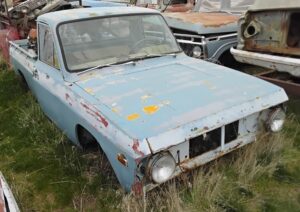 1972–1976 Ford Courier
